Tattoo Removal Options in Vancouver: What's Safe, What to Skip, and What Works.
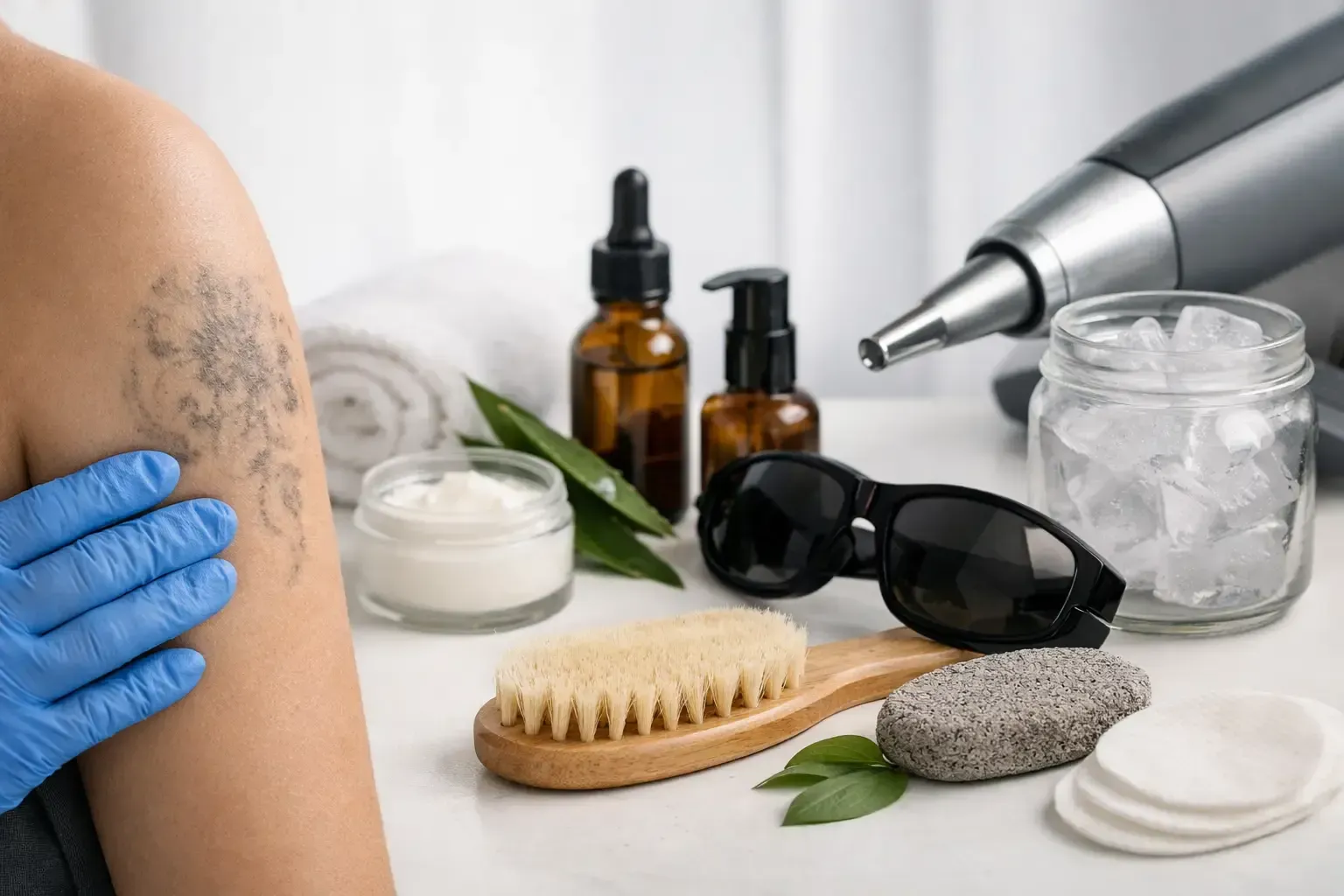
You've decided a tattoo no longer fits. Now you're sorting through the advice. Friends have opinions. TikTok has more. Every clinic between Kitsilano and West Vancouver seems to promise something slightly different.
You want answers from people who work with ink every day. And you need an option that's actually available here in Vancouver.
We'll walk you through every method being marketed to you, including the ones we'd steer you away from. Some carry real risks. One is a partial answer. And one combines the technology and expertise that make the biggest difference to your skin.
First, a Reality Check on Safety in Canada
Tattoo removal is more common than you might think. About 1 in 3 Canadian adults has a tattoo, and a small share say they've outgrown some or all of theirs or would remove them if they could (Narrative Research).
Demand has grown faster than oversight. In a 2015 report in the
Canadian Medical Association Journal, the then-president of the Canadian Dermatology Association noted that removal devices are generally safe and most people treated at non-medical clinics won't have problems, but warned that when treatment goes wrong, the outcome can be serious. He also pointed out that the industry isn't regulated and many operators are poorly trained, sometimes with nothing more than instruction from the laser manufacturer.
The same report described a Quebec case where 18 clients of one removal shop suffered second-degree burns and thick, rope-like scarring, which led the province's college of physicians to look into regulating the industry.
The takeaway is simple.
The method matters, and so do the hands delivering it.
Here's how your options compare.
They're cheap, they ship to your door, and they promise results without a clinic visit. That's where the appeal ends.
Health Canada issued a public warning about these products after receiving four separate incident reports in fall 2014, with reported reactions including skin irritation and scarring. The warning covered gels, creams, and solutions applied to the skin or injected with a tattoo needle, which work by fading the ink or drawing it to the surface to form a scab.
Here's the problem. Tattoo ink sits in the dermis, below the surface layer of your skin. Anything applied from the outside has to damage the skin above it to reach the ink. That's not removal. That's injury with extra steps.
2. Dermabrasion (Avoid)
Some cosmetic clinics still market dermabrasion as a tattoo removal option.
Dermabrasion uses a high-speed rotary tool with an abrasive wheel or brush to sand the skin down through its outer layers. Yes, you read that right. Your skin would be sanded. The area is usually numbed first, but does that give you peace of mind?
Sanding is for wood furniture and cast iron pans, not your skin. Because the ink sits deep, reaching it means removing a significant amount of healthy tissue along the way. The chance of scarring, infection, and uneven texture is simply too high to recommend it.
3. Surgical Excision (Rarely the Right Fit)
If sanding doesn't appeal to you, how about cutting? Surgical excision means a surgeon removes the tattooed skin with a scalpel and stitches the edges together.
To be fair, excision has a place. The
Canadian Society of Plastic Surgeons notes that your surgeon will discuss whether excision or laser is the better choice for your tattoo, and for a very small tattoo, it can be a single-appointment option.
But the trade-off is built in. Every excision replaces a tattoo with a surgical scar. Larger pieces may require staged procedures or skin grafts, with the recovery and risks of any surgery. And if you're planning a cover-up, scar tissue is a far harder canvas for your artist to work on than faded ink.
4. Q-Switch Laser on Its Own (A Partial Answer)
For years, the Q-switched laser was the gold standard. It works by delivering pulses of energy measured in nanoseconds (billionths of a second) that heat and break up ink particles so your body can clear them.
Q-switch technology still has a role. At NIXX, our
Hollywood Spectra laser is a Q-switched system, and its 1064 nm wavelength is valuable for dark inks and for treating a wider range of skin tones with care.
The issue is clinics that stop there. Picosecond lasers like
PicoSure deliver pulses in trillionths of a second. That shorter pulse shatters ink into much finer particles, with less heat spread into the surrounding skin. For many tattoos, that means
more efficient fading, greater comfort, and a gentler healing process.
So if a clinic offers Q-switch alone, it's fair to ask why they haven't made the switch (pun intended).
5. Fading for a Cover-Up (An Alternative Worth Considering)
Not everyone needs full removal. Sometimes the best path forward is
fading the old piece so your artist has room to create something new.
Heavy, dark ink is difficult to cover without going bigger and darker. A few laser sessions can lighten it enough to give your artist real creative freedom. Because NIXX operates inside Adrenaline Studios in Kitsilano, our technicians work alongside tattoo artists every day and understand exactly what a cover-up needs. Learn more in our guide to
fading for a cover-up.
6. The NIXX Dual-Laser System (Recommended)
Here's what we believe gives you the best chance at a clean canvas: the right technology, paired with the right hands.
Two lasers, matched to your ink. NIXX combines PicoSure (755 nm and 532 nm) with the Hollywood Spectra (1064 nm and 532 nm). Rather than forcing every tattoo through a single device, your technician chooses the approach that best suits your ink colours, depth, and skin.
Learn more about the difference
between the PicoSure and Hollywood Spectra, and which is the proper choice for your tattoo.
Technicians who've tattooed. Our team is led by Craig Gilbert, one of North America's most experienced laser tattoo removal technicians, who has trained our other technicians on PicoSure. Because our team understands tattooing, they understand how ink was layered into your skin in the first place. That shapes how they take it out.
Meet our technicians.
Experience you can measure.
NIXX has completed more than 3,500 treatments since 2022.
Comfort built in.
A cooling fan soothes your skin during treatment. You can also apply numbing cream at home 1 to 1.5 hours before your appointment for extra comfort.
Time to heal.
Sessions are spaced 8 to 12 weeks apart, giving your body time to clear the broken-down ink and your skin time to recover.
"A lot of people come to us after trying something else first. A cream that blistered, or a clinic that pushed the power too high to promise faster results. The ink is still there, and now there's damaged skin on top of it. We'd much rather see you first. Patience is what protects your skin." - Craig Gilbert, Senior Technician, NIXX Tattoo Removal
How to Vet Any Tattoo Removal Clinic in Vancouver
Wherever you go, these questions will help you make a confident choice:
Is the laser approved by Health Canada?
A reputable clinic will tell you exactly which device they use and why. In BC, removal businesses are required to have some training, undergo regular health inspections, and use Health Canada-approved devices.
Can you check their inspection history?
Vancouver Coastal Health publishes inspection results for regulated facilities in Vancouver, Richmond, the North Shore, and beyond, and its environmental health officers inspect personal service establishments regularly and respond when a complaint is filed.
Who is operating the laser, and how were they trained?
Training matters. BC's own guidance notes that even a brief accidental exposure to high-power laser energy can cause lasting eye damage or skin burns.
Do they set realistic expectations?
Be cautious of anyone who guarantees a specific number of sessions before assessing your tattoo in person. Every tattoo is different. Black and blue inks typically respond best, while red, green, and yellow are harder to clear.
Do they offer a proper consultation?
You should leave with a clear treatment plan, honest answers, and zero pressure.
"When I look at a tattoo during a consultation, I'm reading it the way a tattoo artist would. How deep the lines went, whether it's been touched up, whether it's a professional or homemade piece. That tells me a lot about how it's going to respond before the laser ever comes out." - Craig Gilbert, Senior Technician, NIXX Tattoo Removal
Your Next Step
You don't have to figure this out alone. A free consultation gives you a personalized assessment, a clear plan, and honest answers about what your tattoo needs.
Have a question first? Call us at
(604) 734-8282 or
book your free consultation today.
When you're ready, we're here.
Sources
- Health Canada, "Consumer Product Update: Health Canada warns of potential risks of tattoo removal products" (RA-43873, 2015): https://recalls-rappels.canada.ca/en/alert-recall/consumer-product-update-health-canada-warns-potential-risks-tattoo-removal-products
- Collier, R. "Should medicine take over tattoo removal?" CMAJ 187(8), 2015: https://www.cmaj.ca/content/187/8/556
- Canadian Society of Plastic Surgeons, "Laser Hair and Tattoo Removal": https://plasticsurgery.ca/procedures/laser-hair-tattoo-removal/
- Vancouver Coastal Health, "Personal service establishment applications and inspections": https://www.vch.ca/en/service/personal-service-establishment-applications-and-inspections
- Government of British Columbia, "Personal service establishments and major planned events": https://www2.gov.bc.ca/gov/content/health/keeping-bc-healthy-safe/pses-mpes
- Narrative Research, "One-third of Canadians have tattoos":
https://narrativeresearch.ca/one-third-of-canadians-have-tattoos-and-most-have-no-regrets-about-getting-them/
NIXX Laser Tattoo Removal is
located in Vancouver, BC, and is connected to
Adrenaline Studios. Our technicians come from the tattoo industry and are laser-certified, so they understand both ink and skin. Laser tattoo removal is not recommended during pregnancy or while breastfeeding, and some medications may require a test spot first; we'll cover all of this during your consultation.
Ready to NIXX Your Ink?
If there's a tattoo you've been tolerating rather than owning, now is a great time to do something about it. Our Vancouver clinic is ready to help you take the first step. Whether you want full removal, a strategic fade for a cover-up, or just honest answers about what's possible, we're here for it.
Your skin. Your choice. Your fresh start.
Recent Posts