Can You Remove a Tattoo the Next Day? Here's What's Actually Happening in Your Skin

You just got a tattoo. And you already know it's not right. Maybe the artist didn't deliver what you discussed. Maybe the size is off, the placement feels wrong, or you just walked out and the feeling hit you immediately. Whatever the reason, you're not alone in wondering whether laser removal can start right away.
The short answer is no.
But the reason why is more interesting than most articles let on, and understanding it will actually change how you think about the timing and the process ahead of you.
What's Actually Happening in Your Skin Right Now
When a tattoo needle deposits ink, it isn't sitting neatly on top of your skin. The needle punctures the outer layer (the epidermis) hundreds of times per minute, driving pigment particles down into the dermis, the deeper layer where connective tissue, nerve endings, and immune cells live.
Your body's immediate response is an inflammatory cascade. White blood cells flood the area. Macrophages (the immune system's clean-up crew) begin engulfing ink particles, which is why some early fading happens in the first few weeks. The skin swells, the surface weeps plasma, and the top layer begins forming a protective crust.
This is not a healed wound. This is an active wound.
Applying laser energy to that tissue would be like treating a burn while it's still blistering. The laser works by generating rapid, intense heat inside the dermis to shatter ink particles. On already-inflamed tissue with a compromised skin barrier, that heat has nowhere safe to go. The risk of blistering, scarring, post-inflammatory hyperpigmentation, and infection increases dramatically.
This is why no reputable, regulated clinic will treat a fresh tattoo. In British Columbia, laser tattoo removal falls under the oversight of the College of Physicians and Surgeons and is governed by health and safety standards that exist specifically to protect clients from this kind of harm. Any clinic willing to treat brand-new ink is not a clinic you want treating your skin.
How Long Does a New Tattoo Actually Take to Heal?
Most top results you'll find online say "8 to 16 weeks." That's a reasonable starting point, but it papers over real variation that's worth understanding.
Tattoo healing happens in distinct phases:
Weeks 1 to 2 (surface healing): The top layer of skin closes over the wound. Peeling and flaking occur as the epidermis sheds. The tattoo may look faded or patchy during this stage. This is the phase most people mistakenly interpret as "healed."
Weeks 3 to 6 (deeper tissue repair): The dermis is still actively remodelling. Collagen fibres reorganize around ink deposits. Inflammation subsides slowly. The tattoo settles into its final appearance.
Months 2 to 6+ (full dermal stabilization):
The ink has fully integrated into the dermal matrix. Macrophages have either engulfed what they can or retreated. The tissue is stable enough for laser energy to work predictably.
At NIXX, our technicians assess each tattoo individually. Small, fine-line work on well-circulated areas (like the upper arm) may be ready closer to the 3-month mark. Larger, heavily saturated pieces, or ink placed on areas with slower circulation like hands, feet, and ribs, often need closer to 6 months before the first session.
The Counterintuitive Truth About New Tattoos and Laser Removal
Here's what most articles skip entirely:
fresh tattoos are not easier to remove than old ones. Many people assume that because the ink is new and hasn't "settled in," it should come out faster. The opposite is often true.
Older tattoos have already begun a slow, natural fading process. The body's macrophages have been working on the ink for years, breaking particles down and carrying them toward the lymphatic system. Some pigment has migrated. The ink load in the dermis is often lower than the day the tattoo was applied.
A brand-new, fully saturated tattoo has maximum ink density. The particles are large and freshly embedded. Laser sessions will be needed to work through that full load from the beginning, with no head start from natural fading.
This doesn't mean new tattoos can't be removed effectively. It means you should go into the process with accurate expectations: a new tattoo, especially a bold or coloured one, may require more sessions than a faded decade-old piece.
What You Should Do Right Now (While You Wait)
The waiting period is not wasted time. What you do in the next few months directly affects your removal results.
Follow proper aftercare for the tattoo itself.
It sounds counterintuitive, but a well-healed tattoo is easier and safer to treat than one that healed with scarring or textural damage. Clean the area gently, moisturize it daily with a fragrance-free product, and keep it out of direct sunlight.
Health Canada recommends keeping new tattoo sites clean and protected to avoid infection and poor healing outcomes.
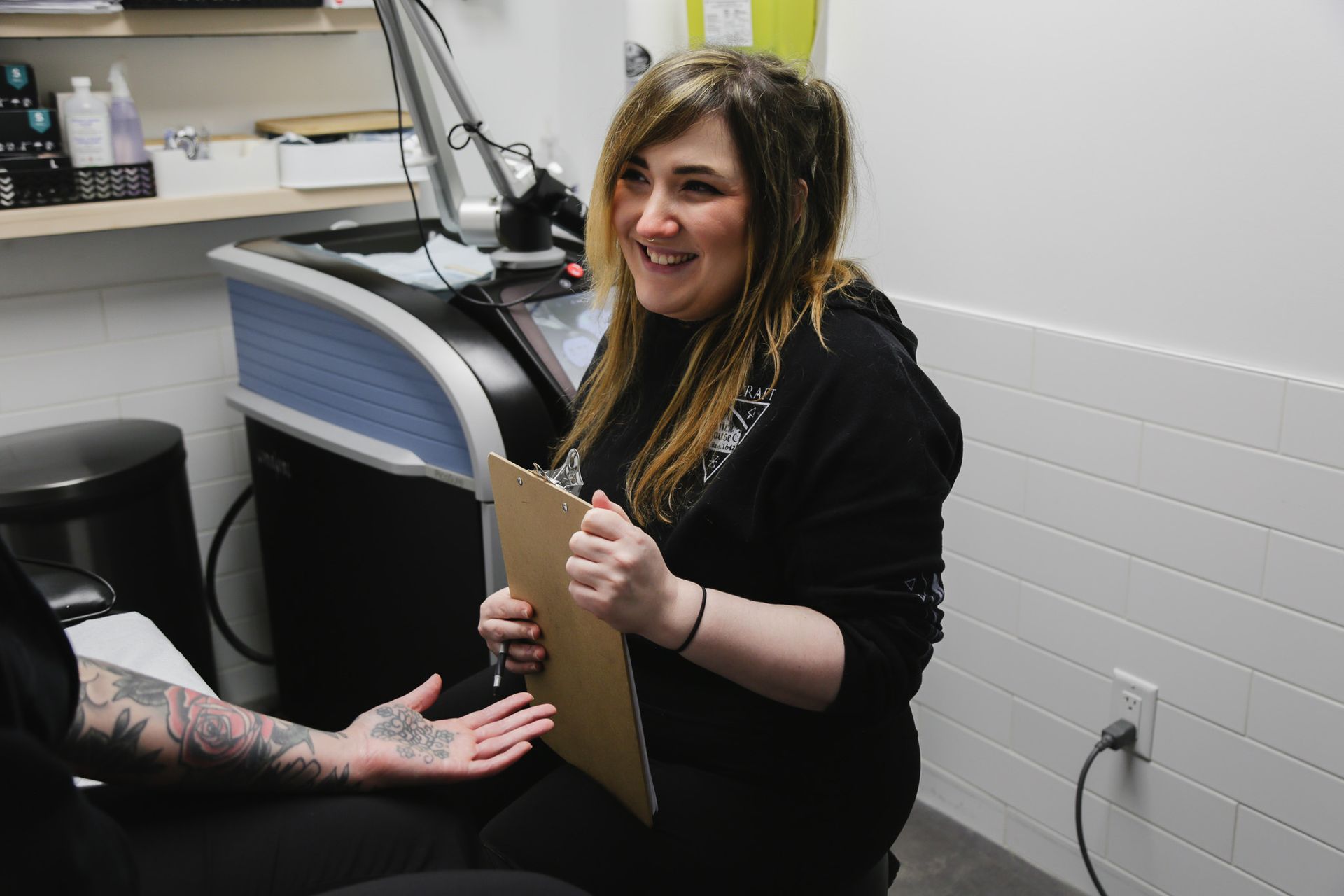
Book a consultation now. You don't have to wait until the tattoo is ready for treatment to start the conversation. At NIXX, consultations are free and involve no commitment. Coming in now means we can assess the tattoo, give you a realistic session estimate, and schedule your first treatment for the right moment. Quality studios book up. Getting on the calendar early means you won't lose additional weeks waiting for an opening once your skin is ready.
Don't try to fade it yourself.
Tattoo removal creams, dermabrasion kits, and DIY saline treatments are not effective and can cause permanent scarring that makes professional removal harder. There is no Health Canada-approved topical tattoo removal product. Save your skin and your money.
The Fade-to-Cover Path: A Faster Option for Some Clients
If the reason you want the tattoo gone is that you didn't get the design you wanted, there is a route that can feel more satisfying more quickly:
fade-to-cover.
Rather than pursuing full removal, which requires more sessions and more time, you can use laser treatments to strategically lighten the existing tattoo to a point where a skilled artist can place a new design over it with far more creative freedom. Lighter, more faded ink gives the cover-up artist a better canvas and opens up design possibilities that heavy, dark ink forecloses.
This path typically requires fewer laser sessions than complete removal, which means you get to the outcome you actually want (a tattoo you love) more efficiently. And because the goal is fading rather than elimination, the threshold for "ready to treat" is the same: the skin still needs to heal fully before laser work begins.
Why the Technician Behind the Laser Matters More Than Most People Realize
Not all laser tattoo removal is equal, and nowhere is that more obvious than with new tattoo assessment.
Determining whether a tattoo is ready for treatment requires genuine understanding of how ink behaves in the skin, how different skin types heal, and how to read tissue that's still in recovery. Our technicians at NIXX come from a tattooing background. They understand how ink is deposited, how depth and saturation vary by artist and technique, and what fully healed dermis actually looks and feels like compared to tissue that's still remodeling.
That background isn't incidental. It's the difference between a technician following a protocol and one who actually understands what they're looking at.
NIXX also uses a
dual-laser system, pairing
PicoSure (which delivers ultra-short picosecond pulses ideal for colour ink and stubborn pigment) with
Hollywood Spectra (a Q-switched Nd:YAG laser that excels on black ink and a broader range of skin tones). Having access to both systems means your treatment plan can be matched precisely to your ink and your skin, rather than forced into whatever single-laser protocol a clinic happens to offer.
A Note on Regulation in BC
If you're doing research and encounter clinics claiming they can treat fresh tattoos, or promoting "same-day removal," be cautious. In British Columbia, laser devices used for tattoo removal are classified as Class II or higher medical devices. Their use is subject to oversight, and operators are expected to follow evidence-based safety protocols.
Health Canada notes that laser tattoo removal carries inherent risks including scarring, infection, and pigmentation changes, risks that increase substantially when treatment is applied to unhealed tissue. Legitimate practitioners understand this. Shortcuts here are not shortcuts at all.
The Honest Timeline
Every tattoo is different, and this is a general framework rather than a guarantee. That said, here's a realistic picture:
0 to 6 weeks: Active wound healing. No laser treatment possible under any safe protocol.
6 to 12 weeks:
Surface healing complete; deeper tissue still remodelling. Consultation appropriate; treatment not yet advisable for most tattoos.
3 to 6 months:
Full dermal stabilization for most tattoos. First treatment session appropriate for smaller or fine-line work. Larger or more saturated pieces may need more time.
6 months+:
Standard starting point for heavily saturated, large, or lower-circulation-area tattoos.
If you want to understand
how many sessions the removal process typically involves, that conversation starts at your consultation, where we can give you a specific estimate rather than a generic range.
What to Do Next
The hardest part of being in this situation is the waiting. That's real. But the months between now and your first treatment session aren't passive time. They're preparation time.
Heal the tattoo properly. Protect the skin. Book your consultation. Get on the schedule.
When the time comes, you want your skin in the best possible condition and a studio with the right technology and the right expertise ready to work with it. That's what we're here for.
Book your free consultation at NIXX Tattoo Removal.
No pressure. No commitment. Just an honest conversation about your tattoo and what the path forward looks like.
Want to understand what removal sessions actually feel like? Read
Does Laser Tattoo Removal Hurt? What to Expect for a clear picture of the experience from the first session forward.
NIXX Laser Tattoo Removal is
located in Vancouver, BC, and is connected to
Adrenaline Studios. Our technicians come from the tattoo industry and are laser-certified, so they understand both ink and skin. Laser tattoo removal is not recommended during pregnancy or while breastfeeding, and some medications may require a test spot first; we'll cover all of this during your consultation.
Ready to NIXX Your Ink?
If there's a tattoo you've been tolerating rather than owning, now is a great time to do something about it. Our Vancouver clinic is ready to help you take the first step. Whether you want full removal, a strategic fade for a cover-up, or just honest answers about what's possible, we're here for it.
Your skin. Your choice. Your fresh start.
Recent Posts