Shatter Stubborn Ink: The Science of Hollywood Spectra Nano-Acoustic Removal

This article is Part 2 of a three-part NIXX guide to laser tattoo removal in Vancouver, BC. While Part 1 detailed the PicoSure® system, here we explore the Hollywood Spectra™, its unique "nano-acoustic" technology, and why it remains the industry’s most trusted workhorse for diverse ink colours and skin tones. In Part 3, we compare the two lasers to help you figure out which one suits your tattoo and skin.
If you’ve looked into tattoo removal, you’ve probably seen plenty of technical terms and big promises. It can be challenging to find a simple explanation of what each laser actually does for your tattoo and your skin. This article is about the Hollywood Spectra by Lutronic. We'll explain how this medical-grade laser works, why its nano-acoustic technology is a meaningful improvement over older systems, and how it handles different ink types and skin tones, including some that other lasers have to treat more cautiously.
The Evolution of the "Workhorse" Laser
To understand what makes the Hollywood Spectra different, it helps to know where older systems fall short. Traditional nanosecond lasers rely primarily on heat to break up ink. That heat doesn't stay in the ink; it spreads into the surrounding tissue. The result is thermal stress on healthy skin, which increases the risk of textural changes or unwanted pigment loss, particularly in medium-to-deep skin tones.
The Hollywood Spectra addresses this by using vibration rather than heat as the primary mechanism for ink disruption.
Shattering Ink with Nano-Acoustic Technology
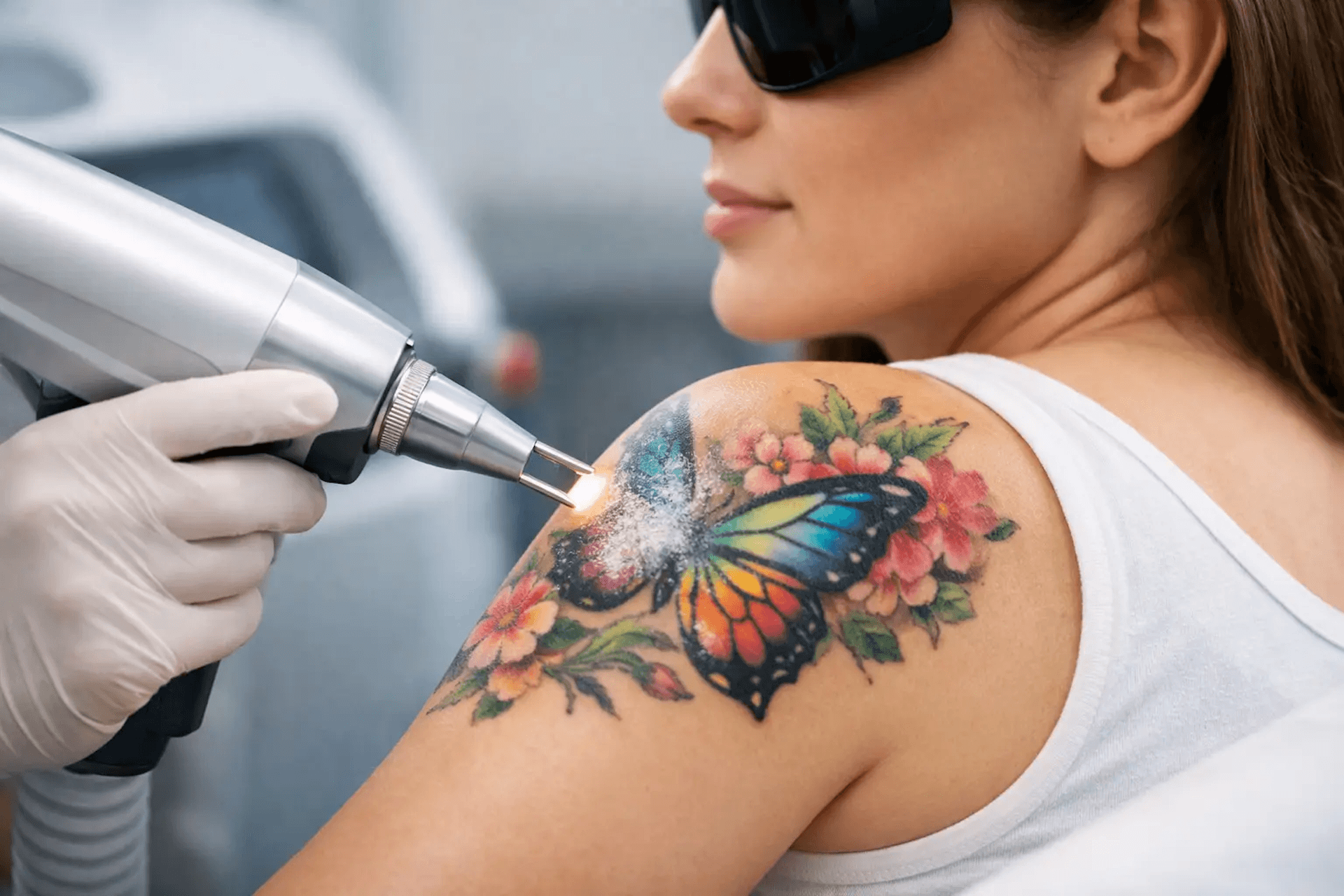
The Hollywood Spectra sends out very short bursts of energy — in the nanosecond range — to create a photoacoustic effect. Instead of just heating the ink, the pulse hits the pigment fast enough to produce a shockwave that physically shatters it.
- HyperSurge™ Resonator: This feature creates a strong "snap" that breaks ink into significantly smaller fragments than heat-dominant lasers typically achieve.
- Easier Clearance: Smaller fragments matter because your body clears tattoo ink through the lymphatic system — the finer the particulate, the more efficiently that process works between sessions.
- Less "Skin Stress": Because the energy targets the ink in just billionths of a second, the healthy skin around it takes in less heat.
Why "Flat-Top" Energy Delivery Matters (IntelliBeam™)
A common problem with older lasers is uneven energy distribution across the beam: stronger in the centre, weaker at the edges. In practice, this creates "hot spots" that can cause uneven fading or halo effects on the skin.
The Hollywood Spectra uses IntelliBeam™ to create a perfectly even "flat-top" beam. This means the energy is distributed evenly across the beam's full diameter, not concentrated in the middle. When every part of the beam delivers the same energy dose, the technician gets more predictable fading across the treated area and a lower risk of uneven texture associated with older beam profiles.
Multiple Wavelengths for Real-World Ink
Different pigments absorb different wavelengths of light. A laser that works well on black ink may have no effect on red or orange. Matching the wavelength to the ink colour is one of the most important decisions made during treatment.
At NIXX, we use the Hollywood Spectra's two core wavelengths:
- 1064 nm: The primary wavelength for deep, dense black and dark blue inks. It penetrates more deeply into the dermis, which makes it well-suited to professional-grade, heavily saturated work. It also has a safer profile for melanin-rich skin tones, where other wavelengths carry a higher risk of pigment disruption.
- 532 nm: Essential for "warm" tones like red, orange, and yellow.
The Hollywood Spectra supports additional dye handpieces at other wavelengths, but we don't use them at NIXX. For the vast majority of tattoos we treat — including complex multicolour work — the 1064 nm
and
532 nm wavelengths, combined with PicoSure's
755 nm, provide the coverage we need across both systems.
Larger Spot Sizes and Deeper Ink Reach
One of the practical advantages of the Hollywood Spectra is its ability to operate with larger spot sizes. This isn't just a matter of covering more surface area per pass; spot size is directly related to how deeply laser energy penetrates the skin.
A larger spot size allows the beam to maintain its energy density at greater depth, so it can reach the ink deeper in the dermis more effectively than a smaller spot can. For dense professional tattoos, heavily saturated black work, or older pieces where the ink has migrated deeper over time, this is a meaningful technical advantage. It's one of the reasons the Spectra and PicoSure complement each other rather than simply overlap: they approach depth and surface coverage differently.
Precision in the Hands of the Right Technician
The Hollywood Spectra is a strong tool. How well it performs depends on the technician's ability to adjust it precisely to your tattoo and skin.
At NIXX, our background in tattooing, not just removal, shapes how we approach these decisions. We understand how pigments are formulated, what colour ingredients are likely in a given ink, and how certain pigment combinations behave under laser energy. We also understand ink depth: a machine-applied tattoo typically sits at a consistent level in the dermis, whereas hand-poked work often shows greater variation in depth within the same piece. Both of these affect how parameters are set and how a session is paced.
In practical terms, this means:
- Variable Spot Sizes: We use small, precise beams for fine lines, outlines, and script; wider settings for larger shaded areas and deeper ink, as described above. All while protecting your skin.
- Customizable Pulse Energy: We can increase the strength for denser ink or reduce it for sensitive areas, such as the neck or ribs.
- Skin Tone Protection: Because the
1064nm wavelength respects natural melanin, we can safely treat darker or mixed skin tones with a much lower risk of hyperpigmentation (darkening) or hypopigmentation (lightening).
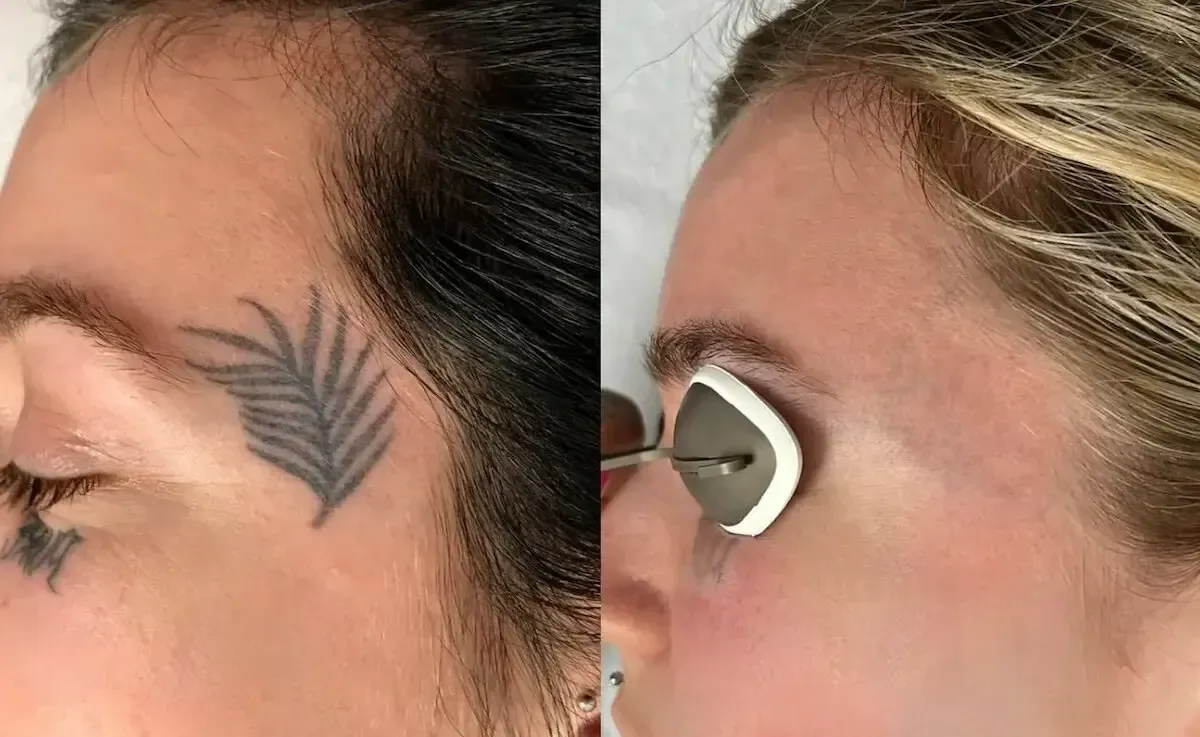
Face Tattoo Removal
After Four Treatments
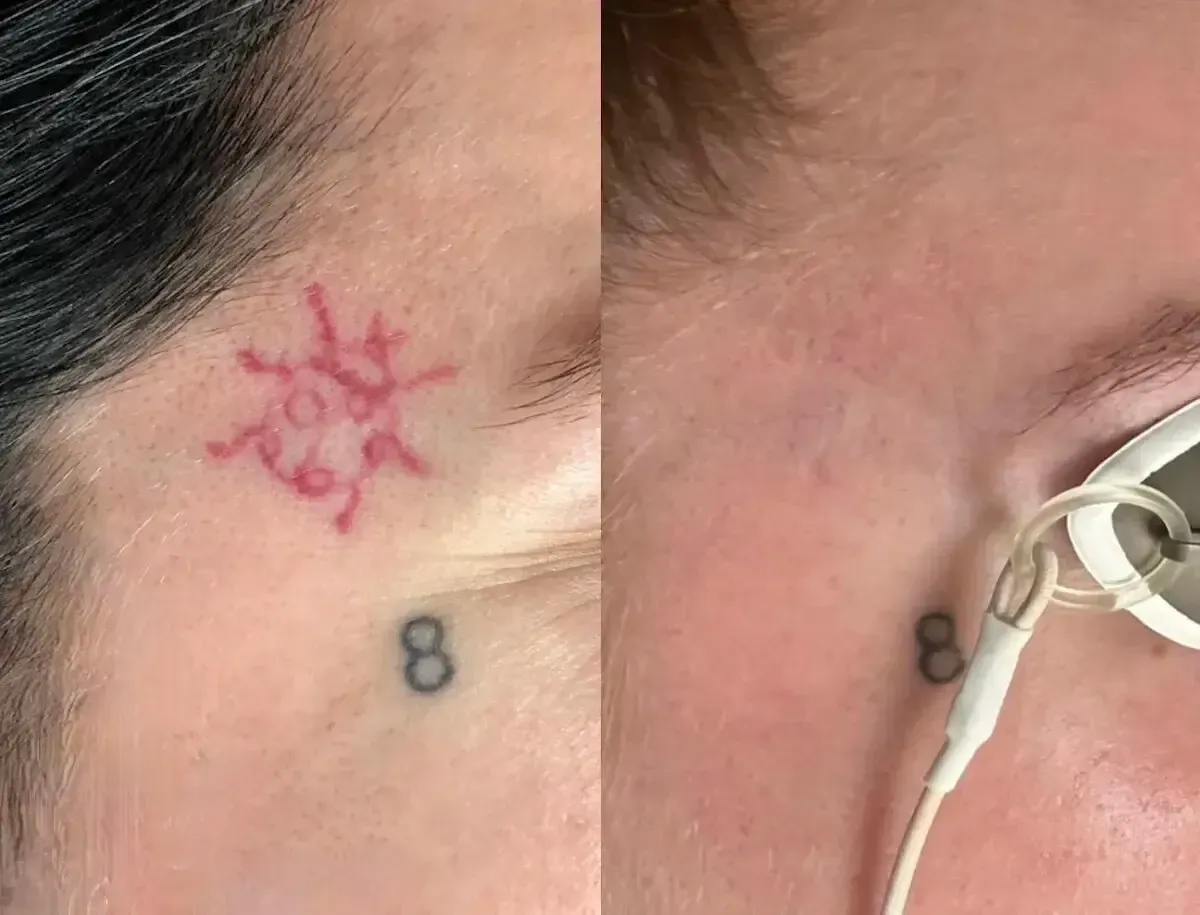
Face Tattoo Removal
Another NIXX Success
Three Wavelengths, One Reason: Your Ink Is Not All the Same
Different ink colours absorb different wavelengths of light. Some inks respond to one wavelength, but not another. That’s why a single-wavelength laser can remove black ink but struggle with green: it’s not about power, it’s about physics.
At NIXX, we use PicoSure’s two core wavelengths:
- 755 nm — the primary wavelength, effective on black, blue, and green inks that sit deep in the skin.
- 532 nm — suited to warmer pigments: certain reds, oranges, and yellows.
Together, these two wavelengths cover the majority of tattoo ink colours encountered in practice. For clients with deeper melanin-rich skin tones where 1064 nm becomes the safer choice, that wavelength is available through our Hollywood Spectra, which is part of why having both systems matters. Part 3 of this series covers how we decide which laser, or combination of lasers, fits your tattoo and skin tone.
In reality, the wavelength isn’t chosen just once for the whole tattoo. It’s picked for each section and colour, based on how your skin responds. This isn’t a sales tactic. It’s simply how science works, and why a proper in-person assessment changes what's possible.
The colour-specific claims here aren't just technical theory. Peer-reviewed research published in journals including the
Archives of Dermatology and Lasers in Surgery and Medicine has documented PicoSure's clearance of blue, green, and yellow inks: colours that older lasers often can’t remove. PicoSure has been the subject of over 26 published clinical studies, which is more documented validation than most laser systems in this space can claim.
What PicoSure Gives a Technician to Work With
The short pulse is the key feature, but what really matters is the control PicoSure gives during each session.
Variable spot sizes let the technician work precisely: tighter on small, detailed areas, wider on larger fields, without over-treating skin that's already been hit in a previous pass. Adjustable fluence settings mean the energy level can be pushed on dense, stubborn ink or dialled back where the skin needs more cautious handling. For ink that resists standard settings entirely, PicoSure includes a boost mode that further shortens the pulse width, applying more concentrated force to recalcitrant pigment without simply cranking up the heat. Wavelength flexibility means the right option for each pigment can be selected mid-session rather than locked in at the start.
All this technology only works if the person using it knows what they’re doing. A powerful laser in the wrong hands won’t give better results: it can actually cause more skin damage. The equipment sets the limit, but the technician decides what results you get.
What to Expect: Healing and Progress
Since the Hollywood Spectra uses mechanical shattering rather than excessive heat, recovery time is usually easier than most people expect.
- The Sensation: Most people say it feels like a series of quick, hot snaps, like an elastic band snapping. We use continuous cooling and, when needed, numbing cream to keep the experience as tolerable as possible.
- The Recovery: Right after treatment, your skin might look pink or mildly swollen, with a response similar to a mild sunburn. Most clients notice that any redness or "micro-crusting" goes away in a few days.
- The Timeline: We space sessions at least 8 weeks* apart. This isn't arbitrary; your skin needs to fully heal, and your lymphatic system needs adequate time to process and clear the fragmented ink before the next session is worth doing. Pushing sessions too close together doesn't speed up removal; it increases the risk of skin stress and doesn't give the previous treatment's results time to develop.
*Some of our
Removalists space client sessions even further apart, at twelve weeks or more, for this reason. We'll give you an honest recommendation based on how your skin is responding at each check-in.
Benefits Of Choosing Hollywood Spectra At NIXX
Hollywood Spectra, on its own, is powerful. In the hands of a tattoo-focused technician at NIXX, it becomes a very precise tool that respects your skin while it clears unwanted ink.
High-Precision On Lines, Shading, And Partial Removals
If you want a full clear-out, a fade for a cover-up, or just one specific element removed, precision matters. Hollywood Spectra lets your technician adjust spot size, pulse energy, and number of passes so they can:
- Trace fine lines cleanly, which is key for names, outlines, and script.
- Soften heavy packing or shading without blowing out the surrounding skin.
- Target only the part you dislike, which is vital if you are editing a large piece or planning a strategic cover-up. You can learn more about this approach in our guide on removing part of a tattoo.
The benefit for you is control. You get a plan that matches your career, your lifestyle, and your long-term tattoo goals, not a generic “erase everything” approach.
Wide Colour Range And Fewer Stubborn Patches
Hollywood Spectra uses multiple wavelengths, enabling the laser to cover a broader range of inks. That includes common black and grey work, as well as more complex colours. In practice, this helps reduce the risk of leftover “ghost” shapes or random bright spots that don't match the rest of your skin.
- Dense black and dark blue ink. The 1064 nm wavelength and Spectra's depth-penetrating capability make it the stronger choice for heavily saturated professional work — the kind that sits deep and resists systems that can't reach it.
- Warm colour families. The 532 nm wavelength addresses reds, oranges, and yellows that a 1064 nm-only system would leave untouched.
Skin Safety, Healing, And Comfort
The laser’s ultra-short pulses focus energy into the ink. Your surrounding tissue absorbs less heat, which helps protect the texture and natural pigment. When you pair that with NIXX protocols for cooling, spacing, and aftercare, you get:
- Lower risk of surface damage compared to more aggressive, older-style lasers.
- Support for smoother healing, so the area blends more naturally as the ink fades.
- Sessions that feel manageable, especially when we combine strong cooling with tailored settings for sensitive placements like ribs or neck. You can read more about placement-specific care in our laser
tattoo removal guides.
Suitable For A Wide Range Of Skin Types
Safe removal on darker and mixed skin tones requires respect for melanin and real experience with parameter selection. Hollywood Spectra allows us the flexibility to adjust wavelength, energy, and spot size to work with your natural pigment, not against it. At NIXX, we combine that capability with a conservative first session and close monitoring, especially if you have a history of hyperpigmentation or scarring.
What the Spectra Can't Control
It's worth being honest about limits, too. Some pigments resist treatment regardless of the system. Some tattoos, particularly heavily layered cover-ups or pieces with certain industrial pigments, take longer than others. The Spectra is a powerful and versatile tool, but it operates under the same biological constraints as any laser: your body's lymphatic clearance rate ultimately determines how quickly the ink is cleared.
Is the Hollywood Spectra Right for Your Tattoo?
The Hollywood Spectra works very well on dense blacks, warm colours, and many skin types, but the best laser is always the one that fits your personal goal.
With the use of the Hollywood Spectra at NIXX, you get serious ink-clearing power, guided by technicians who understand both tattoo artistry and skin behaviour, so your results support your confidence, your career, and whatever you want next on your canvas.
At NIXX, we don't recommend a laser until we've reviewed your tattoo. The system should fit your skin and your ink, not the other way around.
If you want a real assessment of how your tattoo will respond, book a free consultation at our Greater Vancouver studio. We will check your ink’s density, colour, and placement to create a plan just for you, whether you want complete removal or just enough fading for a great cover-up.
What Comes Next?
If you want honest advice about whether Hollywood Spectra is right for your specific tattoo — or whether PicoSure or a combination of both makes more sense — that’s precisely what our free consultation is for. We’ll look at your tattoo in person, give you our honest opinion, and create a plan that fits your skin and your timeline.
Recent Posts